WHEN THE MUSIC STOPS
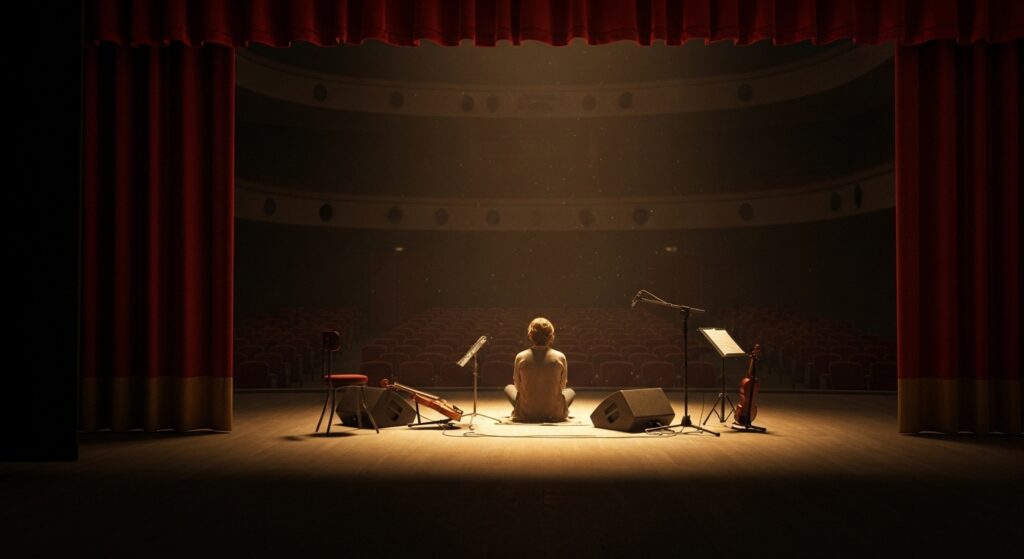
What remains when the curtain closes, the applause fades, and the quiet begins to speak.
A reflective blog for performers, artists, and creatives on the emotional aftermath of performance, creative completion, and major life events – and how to meet the quiet with care, compassion, expansion and grace.
The curtain closes. The applause fades. The recording is finished. The book is done. The performance is over. The offering you poured yourself into has finally reached the world.
And then, often more quickly than expected, the quiet arrives.
For artists, performers, and creators, this moment can be surprisingly tender. What looks like completion from the outside can feel very different on the inside. The concert happened. The audience responded. The work is complete. The event was beautiful. The milestone was reached.
But inside, another experience often begins.
This quieter aftermath is something many performers and creatives know well, even if they do not always name it. It can feel like a post-performance emotional crash, a creative letdown, or simply the vulnerable space that follows intensity, visibility, and completion. It is not weakness. It is often part of being human after giving something real.
Because when the music stops, many things can rise to the surface at once: relief, gratitude, fatigue, vulnerability, emptiness, reflection, even a strange sense of disorientation. After the momentum of creating, preparing, performing, producing, rehearsing, refining, promoting, and carrying something with so much care, the stillness can feel unexpectedly loud.
This is the part people do not always talk about.
We know how to celebrate the big moment. We know how to talk about the opening night, the release, the launch, the standing ovation, the completion. We are far less practiced at speaking honestly about what happens afterward – when the visible moment is over, the structure falls away, and there is nothing immediate left to do.
For a performer, this may happen after stepping offstage.
For a recording artist, it may come after the final mix is delivered.
For a writer, it may arrive after the last page is complete.
For a creative of any kind, it may appear in the space after something deeply personal has been shared.
Many others recognize some version of it after a major life event that asked them to carry, create, or hold so much.
There can be joy in that space, of course. There can be pride, gratitude, and a beautiful exhale. But there can also be a kind of emotional drop that feels confusing when you have worked so hard for the very moment that has now arrived and passed.
Why the quiet can feel so full
Part of it is simple: when we are moving toward something meaningful, our energy gathers around it. We organize ourselves around the next rehearsal, the next revision, the next decision, the next deadline, the next entrance. The creative drive can be incredibly life-giving. It sharpens us. It focuses us. It asks us to become more present, more disciplined, more alive.
But when that current suddenly shifts, the inner system has to catch up.
And deeper still, the silence after the striving can make room for truths we could not hear while we were busy. Exhaustion may show up. So may loneliness. So may the quiet ache of wanting to be seen more deeply than applause or praise can ever fully provide. Even beautiful success does not always soothe the deeper parts of us that long for rest, safety, belonging, or peace.
This is one reason the moments after the performance can be so revealing.
Not because something is wrong.
But because the noise has fallen away.
As a longtime performing artist, I have seen how easy it is to focus on the visible moment – the concert, the audience, the outcome, the response – and to overlook the invisible inner experience that follows. Yet often it is in that quieter aftermath that something essential begins to speak.
I am more tired than I realized.
I gave more of myself than I knew.
Now that this is finished, I do not know what comes next.
And sometimes, beneath all of that, it says something even more important: There is more to me than what I produce. More to me than how I perform. More to me than what I achieve in public.
That is sacred ground.
Because for many artists, the creative life is not just a profession. It is identity, devotion, longing, discipline, expression, offering, and love all intertwined. So when a major moment ends, it can stir questions that go beyond scheduling and productivity. It can touch the deeper self: Who am I when I am no longer ‘on’? Who am I when the audience is gone? Who am I in the stillness between one offering and the next?
These are not small questions. And they deserve more compassion than our culture often gives them.
We live in a world that praises momentum. Keep going. Keep posting. Keep building. Keep producing. Keep moving toward the next thing.
But the soul does not always move that way.
Sometimes the soul needs to sit in the emptied room for a moment and let the deeper experience arrive. Sometimes the nervous system needs time to come down gently, rather than being pushed immediately into the next demand. Sometimes what is needed after the big moment is not analysis, not more pressure, not a new strategy right away – but care.
When the inner critic shows up after the performance
And sometimes, in that quiet, the inner critic wants to take the microphone.
The inner critic may be quick to rise in the silence afterward. And to be fair, that voice may have served a purpose during the creative process – helping you through the technical phases, sharpening your listening, refining the details, and calling the work higher with each pass. But once the offering is complete, that voice has finished its shift. It does not get to lead what comes next. This is where the cheering committee enters, and where the loving voice must grow louder – the voice that reminds you how much courage, care, discipline, talent, and devotion it took to bring the work into being, and that now it is time to receive it with grace, gratitude, and praise.
That shift matters.
Because right after a performance, release, presentation, or meaningful completion is often when we are most open, most tired, and most vulnerable to harsh self-assessment. Was it enough? Could I have done more? Did they want more? Was I as good as I hoped? Those questions can feel loud in the quiet, but they are not always the wisest voices in the room.
Gentle tools for creative recovery
This is why the aftermath deserves real care.
A soft landing can make all the difference. Schedule a call, dinner, walk, or visit with a trusted friend who helps you decompress, unwind, and debrief without turning the moment into critique. If you know you tend to crash hard after giving a lot, do not leave yourself entirely alone with it.
Take a day off if you can. After pouring so much of yourself into something meaningful, it may not be wise to rush straight into the next obligation. Spaciousness helps the body and mind come down more gently.
Reward yourself on purpose. Mark the moment. Let there be some pleasure after the effort: a favorite meal, flowers, a massage, extra sleep, time in nature, a beautiful outing, or some small ritual that tells your system, You are allowed to enjoy what you created.
Return to what restores you. Your favorite rituals matter here – prayer, music, a bath, journaling, candles, tea, beauty, quiet, warmth, or anything that brings you back to yourself.
Sometimes the most important question after the big moment is not, How did I do? but, How well am I caring for myself now that it is over?
The quiet after the applause
The quiet after the spotlight is not empty. It is informative. It reveals where we are tender, where we are depleted, where we are fulfilled, where we are still reaching, and where we may need deeper support. It shows us what applause cannot answer. It invites us back into relationship with ourselves – not only as performers, but as human beings.
There is wisdom there.
There is healing there.
And there is also the possibility of a more integrated creative life: one in which the artist is cared for not only during the visible moment, but afterward too. One in which we honor not only the performance, but the recovery. Not only the brilliance, but the being underneath it.
Perhaps that is part of what the quiet is for.
Not to punish us with emptiness.
Not to expose weakness.
But to bring us home to ourselves.
When the music stops, we meet what applause cannot answer. We meet the heart beneath the effort, the nervous system beneath the performance, and the deeper self that still needs care after the moment is over.
The quiet after the big moment is not the end of the story. It is often where the real listening begins. It is where we notice what was stirred, what was spent, what was beautiful, and what now needs compassion, restoration, and support.
Because what remains when the curtain closes may be more important than we think.
It is the self beneath the role.
The heart beneath the offering.
The soul beneath the sound.
And when we learn to meet that space with care, the aftermath becomes more than a letdown or an empty room. It becomes a place of integration. A place of recovery. A place where something true can return.
If you find yourself in that quieter aftermath – after a performance, a completion, or a major life event – I offer a complimentary Starlight Call: a kinder space to reflect, decompress, explore what is rising, and create tools for the next season. And for those who want deeper support, this can also be the beginning of a more personalized process.
Because sometimes the next real step forward does not begin in the spotlight.
It begins in the quiet, with support.
Sometimes the next real step forward does not begin in the spotlight. And if this feels familiar, please know: you are not failing because the quiet feels harder than the spotlight. It begins in the quiet, with support.
If that speaks to where you are right now, the complimentary Starlight Call offers a gentle place to begin—space to explore what feels tender, what may be asking for healing, and what wants to emerge next with more clarity, compassion, and grace.
© 2026 Karen Olson, Ph.D. All rights reserved